


The Carter Center is a 501(c)(3) charity (tax ID# 58-1454716).
One Copenhill | 453 John Lewis Freedom Parkway NE | Atlanta, GA 30307
(404) 420-5100 | info@cartercenter.org
Copyright © 2026 The Carter Center.


result

Health Programs
Health Programs
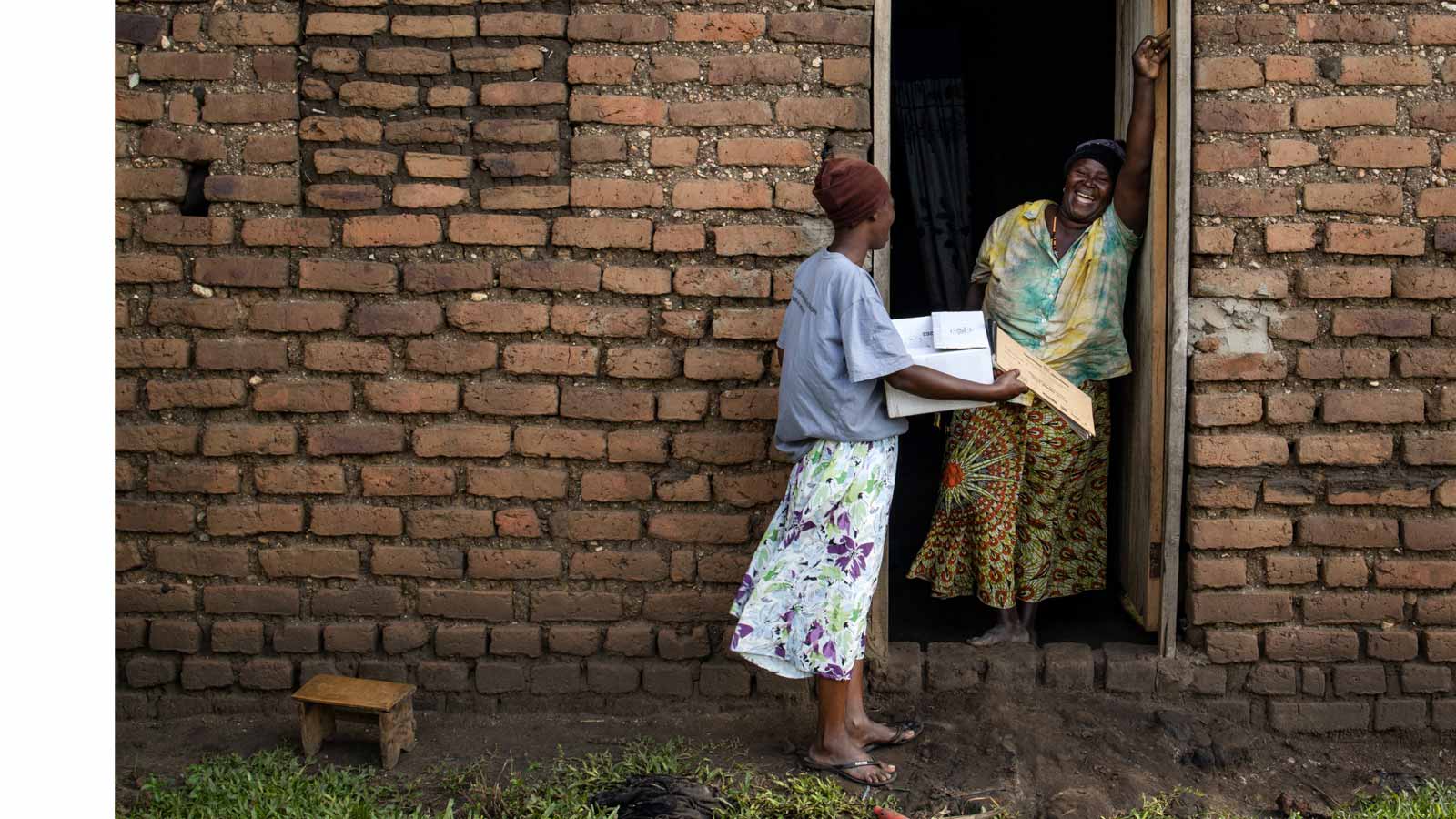
Scovia Naitu (left) prepares to administer ivermectin to a community member to prevent river blindness in Uganda's Lhubiriha area. This was the final treatment campaign there, and the region has now moved to three years of post-treatment surveillance, a testament to the program’s success.
OVERVIEW
STORY
A Future in Focus
Guinea Worm Disease Eradication Program
The Carter Center took a significant step forward in its global campaign to eradicate Guinea worm disease, with just 10 human cases reported worldwide in 2025, the lowest number ever recorded. Forty years ago, an estimated 3.5 million people were afflicted with the disease every year across 21 countries in Africa and Asia.
Only three countries saw human cases in 2025: four cases each in Ethiopia and Chad and two cases in South Sudan. Angola, Cameroon, and Mali reported zero human cases for the second consecutive year. To eradicate Guinea worm disease, animal infections also must be halted; they rose slightly in 2025 to 683, compared with 664 in 2024, down from 887 in 2023. Chad, once the epicenter for animal infections, reduced infections by 47%, its sixth consecutive year of progress.
In May 2025, a Center delegation witnessed the World Health Assembly in Geneva, Switzerland, unanimously adopt a resolution to accelerate Guinea worm eradication. And in October 2025, the world saw the release of the independent film “The President and the Dragon,” which documents the decades-long fight against Guinea worm disease, featuring The Carter Center and its co-founder, President Jimmy Carter.
Joseph Okello keeps close tabs on the dogs in the Ethiopian village of Athete.
He Knows Every Dog by Name
Joseph Okello doesn’t need to consult his notes. The village of Athete in western Ethiopia, he can tell you, is home to 53 dogs and 43 dog owners — and he knows each one by name.
As a Carter Center field officer, Okello runs a proactive dog tethering program that plays a critical role in the fight against Guinea worm disease. Dogs can spread the parasitic infection when they drink contaminated water, then recontaminate water sources a year later when they seek relief from the pain of a worm emerging from a leg or other body part.
To prevent this, The Carter Center helps build and maintain “tukuls” — the local word for doghouses — and provides dog food, veterinary services, and fencing for a dog park where animals can play safely off leash. It’s all part of an effort to keep dogs from running free and perpetuating the disease cycle.
Okello is one of hundreds of dedicated staff and volunteers working across Ethiopia to eradicate Guinea worm disease. With commitment like Okello’s, the Guinea worm’s days are numbered.
LEARN MORE IN THIS VIDEO
River Blindness Elimination Program
The Carter Center continues to work with ministries of health in Africa and Latin America to stop the transmission of river blindness, a parasitic infection that’s one of the leading causes of preventable blindness worldwide. The program expanded in 2025 into Chad, where an estimated 1.7 million people received treatment in July. In 2025, the Center assisted in the distribution of 40 million treatments across eight countries in Africa and the Americas. Since the river blindness program began in 1996, the Center has assisted with about 650 million treatments across the globe.
Trachoma Control Program
For three decades, The Carter Center has led the global fight against trachoma, transforming lives through health education, surgical procedures, and mass drug administration. In 2025, the Center worked to accelerate progress with new strategies, including an increase in the frequency of medication distribution and use of a nonsurgical treatment for less severe cases of trachomatous trichiasis (TT), the advanced and blinding form of the disease. Working with national ministries of health in Ethiopia, Niger, South Sudan, and Sudan, The Carter Center provided 31,284 individuals with vision-saving surgeries, 64% of whom were women. In South Sudan, the Center has identified more than 100 children under age 11 with severe TT who need immediate attention to prevent blindness. The Carter Center is working with partners to find ways to address this urgent need. In a November pilot project, the Center chartered a plane to fly nine children from their rural community to the capital city of Juba to receive sight-saving surgery at the country’s only pediatric eye center. And despite ongoing insecurity in challenging areas, the Center helped distribute more than 11.1 million antibiotic treatments through mass drug administration — including the first distribution in Sudan since war began in April 2023.
Kothome Kernoi, age 8, received surgery to correct the effects of advanced trachoma, a bacterial eye disease.
A Future in Focus
Suffering from advanced eye disease, 8-year-old Kothome Kernoi faced a future without his sight.
Over time, trachoma, a bacterial infection affecting the eyes, had turned his eyelids inward so that his eyelashes scraped his corneas, causing pain and affecting his eyesight. Infection levels are so intense in parts of South Sudan that children as young as 3 are experiencing eye trauma typically only seen in adults. Once vision is lost, there’s no turning back.
The Carter Center stepped in to help Kernoi and eight other children near the remote town of Pibor. They were flown to the country’s only pediatric eye clinic in the capital, Juba, in November 2025 for surgery to correct the in-turned eyelashes. For adults, the procedure can be performed at a local field clinic. But general anesthesia is necessary for children and only available in Juba, some 170 miles as the crow flies from Pibor.
Now, with healed eyes, Kernoi and the other children are thinking about their futures. And this boy wants to be a doctor — a dream now coming into focus.
LEARN MORE IN THIS VIDEO
Schistosomiasis Control Program
Schistosomiasis is a waterborne parasitic infection that damages internal organs. Commonly affecting school-age children, it can cause blood in urine and stool, pain, weakness, and stunted growth. Alongside the Federal Ministry of Health in Nigeria, where more people need treatment for the disease than any other country, The Carter Center has helped deliver 33 million treatments for schistosomiasis since 1999. In 2025, Nigeria continued its transition to full ownership of the schistosomiasis program started with the Center, embedding efforts to rid the country of the disease into national, state, and district-level public health initiatives and local institutions. In Uganda, schistosomiasis treatments were integrated into mass drug administration for river blindness in three districts.
Lymphatic Filariasis Elimination Program
The Carter Center works to eliminate transmission of lymphatic filariasis, a disease that causes swelling of the limbs and genitals, in Africa and the Caribbean. In 2025, the Center assisted in the distribution of nearly 14 million treatments for the disease, bringing the cumulative total to nearly 222 million since 2000. The Center’s work on this disease expanded into Chad and Madagascar, increasing the number of partner countries to eight. Working with the ministries of health in Chad and Madagascar, the Center helped reach more than 7 million people in the two countries for mass drug administration. Survey results from four districts in Nigeria demonstrated that transmission of lymphatic filariasis has been interrupted, meaning all 141 districts historically supported by The Carter Center in Nigeria have met the criteria to stop treatment for this disease. And on the island of Hispaniola, which is shared by Haiti and the Dominican Republic, the Center continued to fight lymphatic filariasis alongside malaria, a life-threatening parasitic disease transmitted by mosquitoes. In Haiti, three districts met key epidemiological benchmarks for eliminating lymphatic filariasis as a public health problem.
People living on the Caribbean island of Hispaniola hope for a future without lymphatic filariasis and malaria.
Integrated Approach, Integrated Success
On Hispaniola, the second-largest island in the Caribbean, Haiti and the Dominican Republic exist side by side. The very different sovereign countries share more than an island; they also share two devastating tropical diseases — lymphatic filariasis and malaria, mosquito-borne infections that have been eliminated everywhere else in the Caribbean.
The Carter Center assists the ministries of health of both countries to help eliminate these two diseases. The countries must work together to ensure success for both.
There’s reason to be hopeful: Since 2010, cases of malaria are down more than 50%. The World Health Organization may soon validate the elimination of lymphatic filariasis as a public health problem in the Dominican Republic. In Haiti, 86% of districts have met criteria for halting mass drug administration.
And while malaria cases increased slightly in 2025 on Hispaniola, the Center is supporting a pilot program to identify and reduce barriers to timely diagnosis and treatment. Grandparents and parents, who’ve seen the scourge of these diseases in their communities, are now looking toward a healthier tomorrow for younger generations.
Mental Health and Caregiver Program
In 2025, the Carter Center’s Mental Health Program merged with the Rosalynn Carter Institute for Caregivers. The Center hosted its second Mental Health Parity Day at the Georgia Capitol and led an awareness campaign focused on Black women, which earned more than 10 million impressions. Our efforts to keep the spotlight on the issue helped lead to the state levying $20 million in fines against insurers violating parity laws.
Thirteen journalists from the United States, Ireland, the United Arab Emirates, and Pakistan were awarded Rosalynn Carter Fellowships for Mental Health Journalism. The Center’s U.S. newsroom collaborative expanded to more than 50 newsrooms in 18 states.
Globally, in addition to celebrating a 15-year mental health partnership in Liberia, the Center secured grants for youth mental health in Sierra Leone, trained health professionals in Nigeria and Uganda, and supported strategic planning and regulation development in Uganda.
Clinician Amelia B. Sayon tends to the mental health of students in Liberia.
Students Need Mental HealthCare, Too
In Liberia, The Carter Center has trained 140 child and adolescent mental health clinicians to help thousands of children overcome adversity. Most clinicians serve in primary care facilities, while others work across eight schools, providing classroom lessons, group therapy, and one-on-one counseling — filling a critical gap for a vulnerable population.
Amelia B. Sayon is one of those clinicians. Based at B.W. Payne Elementary in Monrovia, Sayon was trained as a nurse and long understood the close connection between physical and mental health. Years of civil war and persistent poverty have left many Liberians with deep trauma, and children can carry that burden into the classroom.
Students often face abuse at home, bullying by peers, and other daily stressors. Sayon helps them process these challenges, care for themselves, and support their classmates.
“Working on their mental health helped their physical health,” Sayon said. “It made them focus and improved their education.”
With the right support, students can heal and dream about life after school. Some might pursue a career caring for others, just like Sayon.